While we often think of Martin Luther’s posting of the 95 Theses on October 31, 1517 as sparking the Reformation and the formation of Protestant denominations, what he did was actually a common way of inviting conversation on matters he deemed to be worthy of closer attention by fellow believers. If he had lived in the 21st century, he might have done it through a blog post! Since the anniversary of Luther’s action is coming up, I thought it would be fitting to have a blog post that invites reflection and conversation on an important topic of our age – one that has split our country in recent years but upon which our church leadership has never debated or been split over: the sanctity of all human life and the need to value it and protect it from womb to tomb.
The post is written by John Bivona, an elder at the Dyer location of Faith Church, as it has been a topic of recent research and reflection for him and one that he wanted to write about. The aim of this post is to make sure that American Christians not only continue to pay attention to the safeguard and protect all human life but also to expand our thinking of what that might look like and entail. I’m thankful for John’s partnership in ministry and believe the information and ideas he shares will not only help us think more deeply but also seek to walk more faithfully as followers of Christ. – Pastor Brian
******************************************************************************************************
“If you swallow gum, it will stay in your stomach for seven years.”
“Going outside in cold weather without a hat can give you a cold.”
“Lighting never strikes the same place twice.”
“Humans only use 10% of their brain.”
We’ve all heard statements like these that seemed unquestionably true until they were examined more closely. Some things that were widely believed to be true turned out to be more complicated, or simply untrue, when examined against the evidence. When the facts challenge what we expected to be true and force us to confront reality in new ways, we can say that we have recognized An Inconvenient Truth.
Some beliefs may be harmless when they are wrong, but others carry consequences that can shape our choices, change our behavior and affect the lives of those around us. Today, there is a significant inconvenient truth the church must wrestle with: the 2022 overturning of Roe v. Wade did NOT eliminate abortions in America. In fact, it hasn’t even reduced the number of abortions.
Historically, Christians have believed that human life begins in the womb (at the moment of fertilization; when a woman’s egg unites with a man’s sperm).
For most of my 56 years of living, along with many Christian Americans, I viewed abortion primarily through a political and legal lens. That perspective was shaped, in part, by messaging from some American evangelical organizations and churches that framed the solution this way: ‘elect the right president, who will appoint the right judges, who will hear the right cases, who will pass the right laws and “voila,” abortion will be eliminated.’
The national abortion numbers following the 2022 decision reveal a sobering truth that few anticipated: abortions in America have increased!
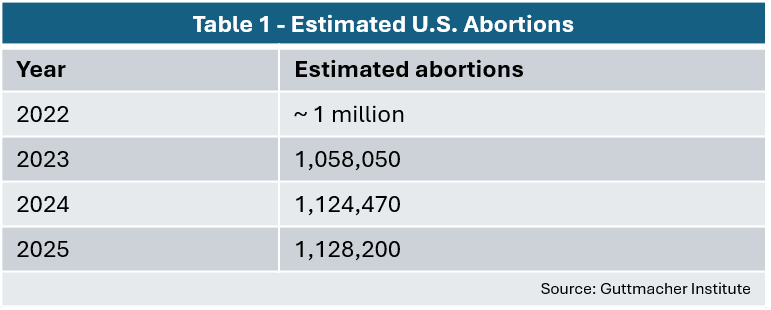
Dobbs did have some effects. Many states enacted restrictions. Abortions declined substantially within some states. But nationally, abortions remained at or above pre-Dobbs levels. Women traveled across state lines. Remote health expanded where medication abortions increased dramatically. Medication abortions alone rose from about 53% of abortions in 2020 to approximately 65% in 2023.
Yet Dobbs revealed a deeper truth within humanity: Changing laws is easier than changing the human heart.
Laws can promote good behavior and can restrain evil; Romans 13:1-4 tells us this. Laws can also reveal sin, Romans 7:7 says, “If it had not been for the law, I would not have known sin.”
The law functions like a mirror. A mirror can show filth on your face; but the mirror cannot prevent you from getting filth on your face nor can it wash the filth off your face. Laws have limitations, they can’t change the heart or wash away our filth!
The overturning of Roe was a historic legal (law changing) event. But it didn’t accomplish its goal to eliminate or even reduce abortions, Christians need to recognize that the challenge before us is larger than legislation.
Decades before the change in law, churches faithfully served women, children, and families by offering practical support, providing resources, walking alongside those facing difficult pregnancies, and proclaiming the dignity and value that every human life is made in the image of God.
That work must continue because the goal was never solely to change the law; it was to cultivate a culture of life regardless of circumstances, whether a child is wanted, unexpected, diagnosed with Down syndrome, facing a genetic disorder, has a physical deformity, or receives a difficult medical prognosis. The value of a human life is not determined by health, ability, or perceived quality of life, but by the God who created that life. Period. Within most of American Christianity this is a widely accepted conviction. The hope is that we will remain faithful to this conviction and not be conformed by the world around us.
However, alongside the ongoing abortion conversations, another issue has emerged, one filled with complexities that may challenge the views many have historically held, or at the very least, force us to confront questions we may have never considered.
The Sanctity of Life and IVF
As a biosafety professional, I work in a field that recognizes a fundamental reality: scientific research and technology can produce tremendous benefits for humanity, but some research and technologies also have the potential to be misapplied in ways that pose significant risks and potential moral dilemmas.
The challenge is to advance research and technology while ensuring it is conducted responsibly, securely, and ethically, and above all, as Christians, ensuring we remain committed to the value and dignity of every human life.
IVF stands for in vitro fertilization. In simple terms, it is a medical process that helps people have children when they cannot conceive naturally. Instead of fertilization occurring in vivo (inside the body), doctors retrieve a woman’s eggs and collect a man’s sperm and combine them in vitro (in the glass or in the laboratory). If fertilization occurs, it creates an early-stage embryo. One or more embryos may then be transferred into the woman’s uterus in the hope that will result in a pregnancy.
It is often used by couples who are struggling with infertility and want to have biological children. Infertility is often deeply painful. Many Christian couples that we know have turned to IVF after years of longing, prayer, and disappointment. Any discussion of IVF must begin with compassion and a willingness to listen.
IVF often involves creating multiple embryos. The minority will be born as infants. Some will fail to result in a live birth (i.e. miscarriage), some will remain frozen in storage, others will become abandoned when storage fees stop being paid. Some will be donated for research. Some are destroyed.
Note: Unlike abortion, other than IVF embryos that result in live births, there is limited data on what happens with the remaining embryos. A very broad estimate is that for every 100 embryos created: 20% result in live birth, 30% go to storage and 50 % result in various outcomes, including research, discarded, destruction or failure to result in a live birth (i.e., miscarriage).
For Christians who believe life begins in the womb, this creates a profound moral tension. These are not insignificant biological cells. They are human lives, in the early stage of development, made in the image of God, it raises deeper questions that should be wrestled with.
What happens to the viable embryos over the next 20–30 years? Will they be stored indefinitely? Will laws eventually set expiration limits? Will economic pressures force widespread disposal? Will embryo adoption (the process where an individual or couple receives embryos that were created through another couple’s IVF treatment) become more common? What will embryo screening consist of?
In addition to these concerns, there are other factors that should be considered. IVF is often paired with genetic screening intended to detect serious diseases or chromosomal abnormalities. Some people view this as a compassionate use of technology, while others see it as raising profound moral questions about selecting which human lives are considered desirable or worthy of being born, particularly when those decisions involve children who may have special needs and who are active participants and valued members of the body of Christ.
As this technology advances, along with artificial intelligence, embryo screening may move beyond disease prevention into trait predictions, such as:
- Likely Health Outcomes,
- Height and Size Ranges,
- Cognitive Probability Scores,
- Athletic Potential, and
- Other genetically influenced traits.
And this is where the moral slope takes shape. What begins as preventing suffering, gradually becomes a process of ranking human potential. Algorithms move from assisting decisions to controlling them, recommendations are made and laws are made based on what is best for society. Slowly the form of a Trojan Horse takes shape, disguising itself as compassion and a better future.
A Biblical Response
Although the future of abortion and IVF are uncertain, what is certain is that human value is not rooted in intelligence, appearance, athletic ability, or genetic advantage. It is rooted in the fact that humanity, all of us, are created in the image of God.
Perhaps the most fitting place to end this blog is where we began- the human heart. Our questions should not focus on, “What does the law allow?” but “What does God require of us?” Our mandate from our King is directly stated in scripture, Matthew 22:37-39 can be summarized by this, “Love God, Love People.” 1 Corinthians 13 defines what God’s love looks like: it is kind, it doesn’t envy, it’s not proud or rude, it doesn’t insist on its own way, it’s not resentful, it doesn’t rejoice in wrongdoing and it rejoices in the truth.
When God’s love begins to shape our hearts, we begin to see the suffering of the people around us with greater compassion. We see the young woman who feels alone and believes abortion may be her only option because her circumstances seem overwhelming. We see the couple who desperately longs for a child after years of infertility, disappointment, and prayer.
And at the same time, we see the embryos created, human lives with no voice and no ability to advocate for themselves. Christian love does not ask us to choose between compassion for those who are hurting and conviction about the value of human life.
Compassion and conviction are not an either/or; they are a both/and.
As the body of Christ, let us remain fixed to the truths of scripture while at the same time speaking the truth with love and compassion. In an age of rapidly advancing technology, where the world around us seems to be tossing like a sailboat in a storm, my prayer is that we are anchored to the unchanging word of God
Ephesians 4:14-15, reminds us, “Instead (of acting childish), speaking the truth in love, we will grow to become in every respect the mature body of Him who is the head, that is, Christ.”
Questions about the Bible or theology? Email them to Pastor Brian at Theology@WeAreFaith.org. You can also email to be added to the list that receives weekly emails with our blog posts.
Unless otherwise noted, all Bible translations are from the Christian Standard Bible (CSB), Copyright © 2017 by Holman Bible Publishers.